Mask or Painted Face? Two Routes to a Stage Character
Mask or painted face? Compare how each shapes a stage character’s identity, directs attention to movement or expression, and helps you choose a form for rehearsal.
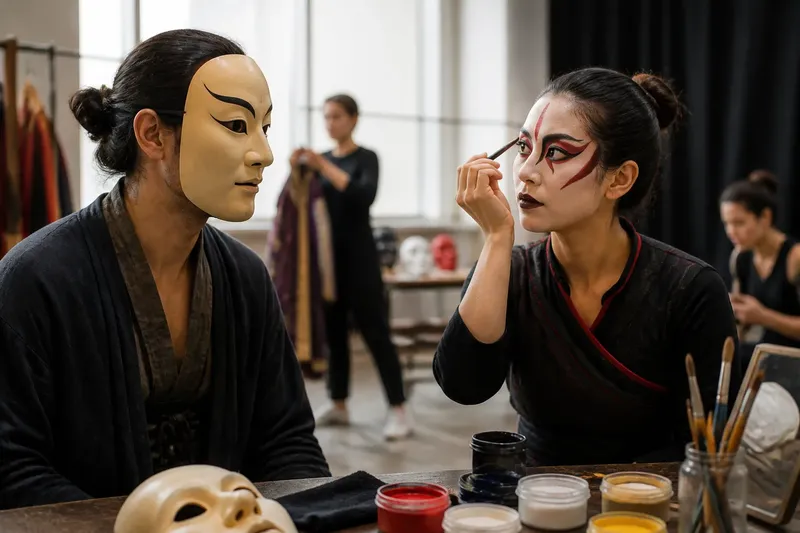
Should the audience read a stage character through a fixed face or the performer’s changing expression? Mask or painted face shapes that first impression: one transforms the head into a designed shape, while the other keeps the actor’s features visible. The right choice depends on what the scene asks the audience to notice.
A mask turns the head into a designed shape
A mask replaces or alters the face’s visible outline. Its brow, nose, mouth, color, and surface can suggest an identity before the performer speaks. Even when still, a mask may seem stern, comic, watchful, or uncanny.
Because its expression does not change, movement carries much of the emotional work. A turn of the head, a tilt toward another character, or a pause facing the audience can change how the same mask feels. Shoulders, hands, stance, and pace matter too. Small, precise gestures often keep the image legible; busy movement can blur the mask’s silhouette.
A mask can suggest a role, creature, or social identity that extends beyond one performer. That can suit a production where the face should remain consistent as performers change. Its meaning, though, depends on the tradition and context in which it is used.
The tradeoff is that the audience cannot see the performer’s natural facial expression. Depending on its construction, a mask may also affect sight, speech, or comfort. Consider how it sits, whether the eyes are visible, and whether the audience can read movement from its seats.
Choose a mask when the character’s outline, fixed expression, or transformation matters more than facial changes.
Paint keeps the performer’s expression visible
Facial paint adds lines, color, shading, or patterns while leaving the face exposed. It can emphasize the eyes, reshape the apparent brow, sharpen the mouth, or create a graphic identity. A raised eyebrow or tightened mouth remains part of the character’s expression.
This can support roles that shift quickly between emotions or depend on subtle reactions. The audience sees both the designed image and the performer’s changing features.
Paint does not automatically make expression easier to read. Strong shapes may pull attention toward one feature, while intricate detail can become visual noise from far away. Painted lines also move as the mouth opens or the forehead wrinkles. That shifting quality may suit a changing character, but not one meant to look unalterable.
Design choices depend on the performer’s features, the production’s visual language, lighting, costume colors, and audience distance. Paint also takes time to apply and remove. Check product labels and production guidance; consult a qualified professional if a skin reaction or other health concern arises.
Choose paint when the performer’s changing expression is part of the character’s meaning.
Compare the forms by the signal the audience needs
Ask what the audience should notice when the character first appears, then what should hold attention as the scene develops. A powerful silhouette or a fixed face whose meaning changes through movement may call for a mask. A visible reaction, shifting emotion, or direct connection through the eyes and mouth may call for paint.
Consider how the form fits the performance. A mask asks the performer to communicate through the body and timing while keeping the designed face legible. Paint leaves facial movement available, but the performer may need to balance it with strong visual marks. Neither option is inherently more expressive; each directs expression to a different place.
Imagine a devised scene about a night watchman who appears calm while the town grows anxious. The starting point is a character whose stillness should contrast with the surrounding movement. The director asks the performer to hold a quiet stance while the other actors cross the stage; the team then checks the view from the back row. If the intended effect is an unreadable emblem, they choose a mask and observe whether its outline remains clear as the performer turns. If the story instead depends on the audience seeing fear emerge in the watchman’s face, they choose paint that leaves the features exposed and check whether the changing expression reads from that same viewpoint. The decision follows the scene’s central signal, not a general preference for one form.
Before settling on a design, make each observation lead to a choice:
- First impression: If the character’s fixed outline is the first signal, choose a mask; if the audience needs to see the actor’s face, choose paint.
- Source of expression: If head angles and body movement carry the scene, try a mask; if eye and mouth changes carry it, try paint.
- Viewing conditions: If fine painted detail disappears from the audience’s seats, simplify the design or use broader shapes; if the mask’s outline is hard to read, adjust its shape or reconsider paint.
- Performer’s movement: If the mask obstructs sight, speech, or a required gesture, revise its construction or choose paint; if paint distracts from the intended physical action, simplify it or choose a mask.
- Design context: If the visual reference has a specific cultural or theatrical context, clarify its relevance and seek appropriate guidance; if the design relies on a vague stereotype, rethink it before rehearsal.
- Preparation and comfort: If applying or removing paint creates a concern for the performer, consult product guidance and a qualified professional as needed; if a mask causes discomfort, adjust the fit or choose another form.
Questions about choosing a mask or painted face?
Can a mask suggest more than one emotion?
Its surface stays fixed, but angle, distance, stillness, and the performer’s response to others can change its apparent mood. A mask that seems comic from one position may feel severe when held motionless toward the audience.
Does facial paint make subtle expression easier to see?
It leaves facial changes visible, but the design and viewing conditions matter. A mark that strongly emphasizes one feature may draw attention away from another, so consider the whole face in the production’s light.
Can a production combine a mask and paint?
Yes, if each has a distinct job rather than competing for attention. A partial mask might establish a fixed shape while paint highlights the exposed eyes or mouth, provided the performer can move and communicate comfortably.
Which option suits a first-time performer?
There is no universal answer. A mask may clarify a bold physical role, while paint leaves familiar facial cues available; comfort, character demands, and rehearsal time are better guides than assumed ease.
Give the character’s expression a clear home
Mask or painted face is not a contest between a more theatrical choice and a less theatrical one. It is a decision about where the audience should look and whether the character’s identity changes or resists change. A mask puts that work in the designed face, the performer’s movement, and the relationship between them. Paint keeps the features visible within a deliberate visual frame.
During rehearsal, ask the performer to hold the character’s defining moment and watch from the audience’s viewpoint. If the face dominates when the body should speak, or the body must carry more than the role can support, reconsider the balance. For mask or painted face, the useful question is simple: can the audience see the intended expression without the performer having to fight the form?