The Circle Around the Story: What In-the-Round Changes
In-the-round theater places spectators around the action. See how this layout shapes entrances, sightlines, movement, and the feeling of shared space.
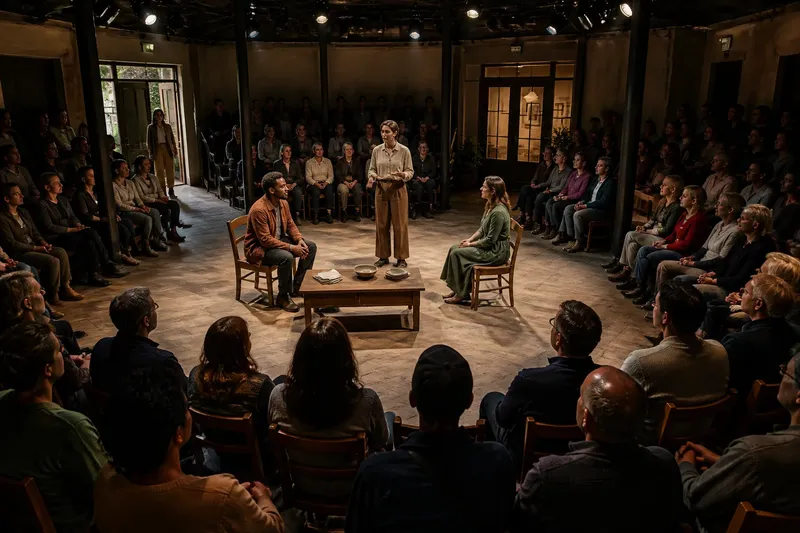
How do you stage a story when spectators sit on every side of the action? In-the-round theater puts the audience around a shared central space, so entrances, gestures, and pauses must reach several directions rather than one fixed front.
The arrangement can make a performance feel close and communal, but it changes the practical grammar of staging. There is no dependable backstage edge to hide behind, no single view that tells the whole story, and no neutral direction for performers to face for long. The room becomes an active part of the telling.
In-the-round theater removes the front of the room
In a conventional end-on theater, the audience faces one playing area. In-the-round theater places seats on all or most sides of a central acting space. That space might be a square, circle, or polygon; the defining feature is the audience’s encircling position.
“Round” describes the relationship, not necessarily the shape. A rectangular floor with four banks of seats around it can function in the round. So can a circular playing area surrounded by movable chairs. The spectators look inward toward the same central action instead of toward a framed stage picture.
This redistributes attention. A performer who faces one section may show their back to another. A table, doorway, or cluster of actors can look clear from one seat and partly blocked from the next. The director is composing for several views, not a single image.
Think of in-the-round staging as deciding how a story travels among people who share its center.
Entrances become routes through the audience’s world
Without a hidden wing at the edge of the stage, performers need a route into view. They might enter through an aisle, pass through a gap between seating banks, emerge from an audience doorway, or begin already present in the playing space. Each choice changes how the audience experiences the arrival.
An aisle entrance can make a character seem to come from the spectators’ world. It can also draw attention away from the central action. A concealed door or screened passage preserves surprise, but should not privilege one side of the room. In some productions, a performer stands from a seat. That can feel intimate, though it asks nearby spectators to accept a sudden change in who is watching and who is performing.
Exits pose the reverse problem. A character may leave close to some spectators and far from others. If the departure matters, a deliberate crossing can give the whole room time to register it. If the story calls for an abrupt disappearance, a clear threshold or coordinated distraction can help.
Say you are staging a scene in a community hall with a central playing area and four seating sections. The character first enters down the west aisle, then returns through a doorway behind the north seats. The first arrival brings the character through the audience’s space; the second makes them seem to come from beyond it. The routes give the returns different meanings without changing the room.
Map entrances and exits as routes, not just as points where actors appear.
Sightlines depend on movement and selective focus
In-the-round staging cannot keep every face visible to every seat at every moment. Trying to do so can produce stiff, mechanical turns. Instead, performers shift their focus through the room as a scene develops, allowing different sections to receive a clear view in turn.
A small pivot can include a new group without turning a conversation into a sequence of announcements. A performer might begin angled toward one section, then open their stance toward another when a thought changes. In a group scene, actors can form a loose arc rather than a straight line, leaving gaps through which more spectators can see faces and reactions.
Furniture needs the same care. A tall chair, coat rack, or table can create useful levels and boundaries, but may hide essential business from one seating bank. Low, movable objects often leave more options. If a large object matters to the story, the production can reposition it as part of the action rather than treating it as a fixed picture.
Light and sound must serve the whole room, too. A bright source aimed toward one section may glare into another, while a voice that carries well in one direction can lose clarity elsewhere. The solution depends on the venue, but the practical question stays the same: can the audience follow the moment without being asked to ignore a major part of the room?
During rehearsal, watch from several seats instead of judging the scene only from the playing area. If an important expression, object, or exchange repeatedly disappears from one section, adjust the blocking or placement.
Shared space changes how the audience feels present
Surrounding the action can make spectators more aware of one another. They hear a response from across the room, notice someone leaning forward, or see the same event from another angle. That awareness can create a sense of shared gathering, even when the performance asks for quiet attention.
Closeness has limits. Performers should not assume that proximity means participation. Some audience members may enjoy being near the action while preferring not to speak, move, or become part of a scene. A production can make the room feel open without treating spectators as performers.
In-the-round rooms can create tension between intimacy and exposure. A private conversation at the center is visible to many people, yet no one has the exclusive, frontal view of a spectator in a conventional auditorium. The surrounding audience becomes part of the visual environment, so a pause may feel less like a break in the play and more like a moment everyone is holding together.
That effect depends on local audience customs and the room. Some gatherings welcome audible responses; others expect silence. Shape the staging for the event rather than assuming all audiences respond alike.
What should a production settle before choosing the room?
Does in-the-round mean a circular stage?
No. The defining feature is seating around the performance, not a perfectly round floor. A square or irregular space can create the same inward-facing relationship.
Where do actors wait before entering?
They may use corridors, doors, screened corners, or routes through the seating area, depending on the venue. The chosen path affects whether an entrance feels hidden, public, or connected to the audience’s space.
Can every spectator see the action?
Not from every seat at every instant, and that is normal. Clear blocking, careful object placement, and changes in performer focus help distribute important moments around the room.
Does the audience have to interact?
No. Being close to the performers does not automatically make spectators part of the action. A production can invite attention and shared presence while leaving participation optional.
Design the room around the audience’s journey
Start by looking at the room from the audience’s point of view. Notice doors, aisles, columns, low ceilings, and places where one seating section may lose sight of the center. Then consider how performers can enter, leave, and redirect attention without making one part of the audience feel like the only intended witness.
For a flexible rehearsal space, chairs or benches can mark the seating banks before anyone settles on a set. Tape can indicate the playing boundary, while a few lightweight objects help reveal where sightlines close. These planning aids do not replace checking the actual venue. For access, fire routes, or technical installation, follow venue rules and consult the appropriate qualified staff.
The strongest in-the-round staging does not force every moment to face everyone equally. It gives the room a changing pattern of attention: an entrance from one side, a response across the center, a pause that lets spectators see one another. Treating in-the-round theater as a journey through shared space helps the room support the story rather than compete with it.
Before settling on a route or arrangement, make sure the people who need to use the room can move through it comfortably. A clear path can serve both the story and the audience.